
 EN
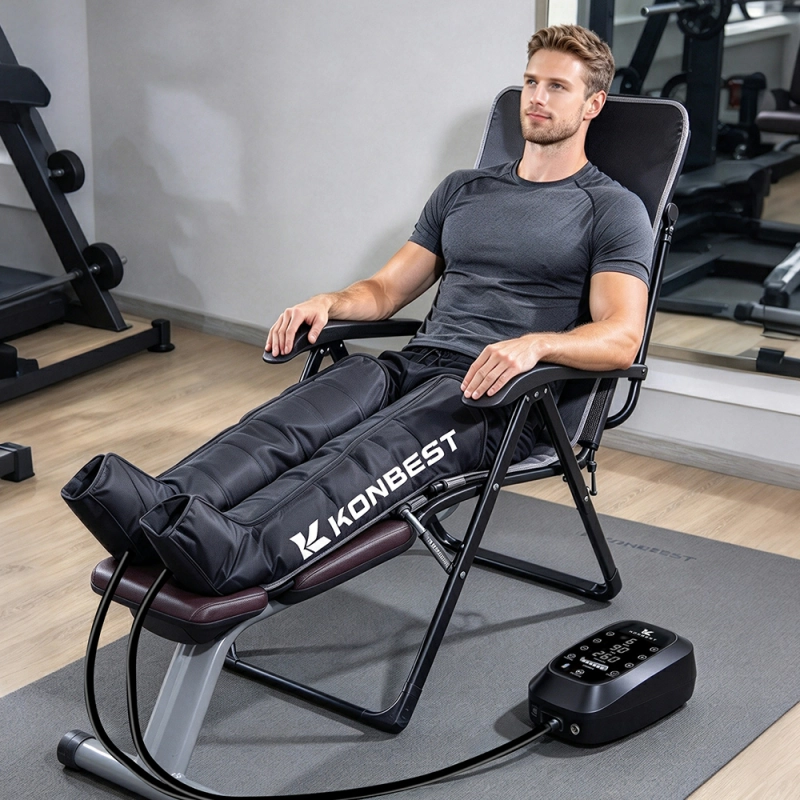
Professional recovery businesses need equipment that can handle real daily use. Gyms, clinics, sports facilities, recovery centers, and fitness retailers are looking for compression systems with clear technical specifications, reliable operation, flexible product choices, and stable supply.
For distributors, wholesalers, resellers, and importers, compression boots wholesale can be a practical way to build a professional recovery equipment range. The key is not simply buying more units. It is choosing the right models for different customer groups and working with a manufacturer that can support samples, private label production, quality control, and repeat bulk orders.
KONBEST provides 4-chamber, 6-chamber, and 8-chamber compression boots for different professional applications. Its product range includes portable, rechargeable, multi-mode, and high-pressure configurations, giving B2B buyers more flexibility when building a recovery product portfolio.
Table of Contents
- Why Compression Boots Are Important for Professional B2B Buyers
- What Makes a Professional Compression Boot Different?
- How to Choose the Right Model
- For Gyms and Fitness Clubs
- For Clinics and Recovery Centers
- For Sports Teams and Training Facilities
- How Distributors Can Build a Product Portfolio
- Private Label Compression Boots for Resellers
- How to Evaluate a Compression Boots Manufacturer
- Why Choose KONBEST for B2B Supply
- Q&A
Why Compression Boots Are Important for Professional B2B Buyers
Compression boots are no longer limited to home users. Professional recovery equipment is now used across gyms, sports training facilities, recovery centers, physiotherapy businesses, fitness retailers, and other wellness channels.
For a B2B buyer, this creates several sourcing questions:
- Which chamber configuration fits the target customer?
- What pressure range is appropriate?
- Is wireless operation important?
- How long should the battery operate?
- How many massage programs are needed?
- Will the product be used several times every day?
- Can the manufacturer provide private label customization?
- Can the factory support medium and large orders?
A professional purchasing strategy should answer these questions before the order is placed. Buying a product only because it has a low unit price can create problems later if the model does not match the customer's application.
A better approach is to divide the market into customer groups and then match each group with the right technical configuration.
What Makes a Professional Compression Boot Different?
A professional compression recovery boots system should be evaluated by its complete specification, not only by its appearance.
| Feature | What B2B Buyers Should Check | Business Value |
|---|---|---|
| Chamber count | 4, 6, or 8 chambers | Creates different product levels for different customers. |
| Pressure range | Maximum and minimum pressure | Provides more flexible operating settings. |
| Massage programs | Number of modes | Helps serve different user preferences. |
| Airflow | L/min and inflation time | Important for frequent professional use. |
| Battery | Capacity and working time | Useful for wireless and mobile applications. |
| Noise | Pump noise level | Important in clinics, recovery rooms, and quiet gyms. |
| Control system | LCD, touch screen, remote, or app | Affects ease of operation and product positioning. |
| Maintenance | Detachable motor and service design | Can make maintenance easier for high-use equipment. |
KONBEST's current product range includes several configurations. For example, the 9690K-D uses a 6-chamber overlapping design, a 5200mAh rechargeable battery, six massage modes, 15 L/min air delivery, and operation below 45 dB. Its listed full inflation time is about one minute.
The 9690K-E also provides a 5200mAh battery, six massage modes, a color LCD screen, and pressure adjustment from 30–260 mmHg, with a low-noise pump design.
These specifications show why B2B buyers should compare the complete product configuration rather than looking only at chamber count.
How to Choose the Right Model
The right model depends on the customer, location, frequency of use, and expected product position.
A simple selection logic is:
- Need simple and portable equipment? Consider a 4-chamber configuration.
- Need more functions for professional users? Consider a 6-chamber model.
- Need a higher-end product category? Compare 8-chamber systems.
- Need mobile operation? Choose a rechargeable wireless configuration.
- Need frequent use? Pay close attention to airflow, battery, pump performance, materials, and maintenance.
- Need a branded product? Confirm OEM and private label options before ordering.
This logic can help distributors avoid filling their warehouse with similar products that target the same customer.
For Gyms and Fitness Clubs
Gyms often need recovery equipment that is easy to operate, easy to move, and suitable for repeated daily use. Staff may need to explain the basic controls quickly, while users may prefer a product that does not require complicated setup.
A 4-chamber model can be a practical starting point for this market. KONBEST's 9490 range includes portable configurations with rechargeable batteries, adjustable pressure, digital displays, and multiple massage programs.
The 9490 Standard, for example, uses four overlapping air chambers, a 3200mAh battery, single-leg or dual-leg operation, a 9 L/min pump, approximately two-minute inflation, three massage modes, and pressure adjustment from 50–200 mmHg.
For a gym equipment distributor, this type of model can fill the general professional recovery category. A higher-specification 6-chamber model can then be offered to customers who want more functions.
For Clinics and Recovery Centers
Clinics and recovery centers normally have more demanding purchasing requirements. The equipment may be used repeatedly throughout the day, so stability, control, comfort, maintenance, and technical performance become more important.
The 9690K-C is one professional option in the KONBEST range. It has six chambers, a 30–260 mmHg pressure range, six massage modes, a 5200mAh battery, 15 L/min air outlet, 10–90 minute time settings, and a noise level below 45 dB.
Its colored LCD display also provides a clear interface for operating the system. The product page lists a two-year warranty for this model.
For a clinic equipment distributor, these specifications can create a clear professional product position. Buyers can compare the model with simpler 4-chamber products and select according to the needs of each customer.
When supplying clinics or other regulated markets, buyers should also confirm the applicable product documentation and regulatory requirements for the destination country.
For Sports Teams and Training Facilities
Sports teams need a different type of flexibility. Equipment may be used in training rooms, recovery areas, competitions, or while traveling.
Wireless operation can therefore be useful. The KONBEST 9490Pro provides cordless operation, a 3200mAh rechargeable battery, app or remote control, five massage modes, and pressure adjustment from 30–240 mmHg. It can also be used on one leg or both legs.
For a more advanced professional product, the 9690K-D provides a 6-chamber overlapping design, 5200mAh battery, six massage modes, 15 L/min air delivery, and below-45 dB operation.
This creates a useful product ladder for sports equipment distributors:
- Portable 4-chamber systems for flexible use
- 6-chamber systems for professional training environments
- 8-chamber systems for higher-end recovery equipment ranges
How Distributors Can Build a Product Portfolio
A distributor does not need ten similar compression boot models. A better strategy is to give each product a clear role.
| Target Market | Product Direction | Main Features to Prioritize |
|---|---|---|
| Gyms | Portable 4- or 6-chamber boots | Simple controls, battery, comfort, pressure adjustment |
| Fitness retailers | Portable wireless products | Design, controls, battery, packaging |
| Sports teams | Professional 6- or 8-chamber models | Pressure, airflow, battery, massage modes |
| Recovery centers | Higher-specification systems | Chambers, pressure, controls, noise, maintenance |
| Private label brands | OEM/ODM configurations | Logo, color, packaging, accessories, specifications |
This structure makes compression boots wholesale purchasing more efficient. Instead of ordering products without a clear market role, buyers can build a small range that covers different customer requirements.
For medium and large B2B orders, this approach can also make inventory planning easier. Each model has a specific customer group, sales channel, and product position.
Private Label Compression Boots for Resellers
Many resellers want to build their own recovery brand instead of selling products under a factory name. This is where private label support becomes important.
KONBEST supports private label services such as logo, color, packaging, and accessory customization. OEM and ODM requirements can also be discussed according to the selected product and project.
A practical private label process can follow these steps:
- Define the target market.
- Select the product configuration.
- Confirm pressure, chamber, battery, control, and massage specifications.
- Request a sample.
- Test the product and packaging.
- Confirm logo, color, packaging, and accessories.
- Approve the final specification.
- Confirm MOQ, production time, inspection, and shipping.
- Start the medium or large production order.
KONBEST states that 2-day sampling and 7-day shipping are available under suitable project conditions. Actual timing should be confirmed according to the selected model, customization level, order quantity, and destination.
How to Evaluate a Compression Boots Manufacturer
Choosing a compression boots manufacturer is more than comparing factory prices. For medium and large B2B orders, supplier capability can directly affect product consistency and future purchasing.
Before confirming an order, distributors, wholesalers, and importers should check:
- Factory production capacity
- R&D and engineering capability
- Product testing and quality inspection
- Sample approval process
- Standard product MOQ
- Private label MOQ
- Production lead time
- Packaging and accessory options
- Warranty terms
- After-sales support
- Applicable compliance documents
- Factory inspection support
A good supplier should also explain the differences between its models clearly. This helps buyers make a technical purchasing decision instead of choosing only by price.
Why Choose KONBEST for B2B Supply
KONBEST is an EU-registered sports recovery brand with 17 years of R&D and manufacturing experience. The company supplies products to more than 100 countries and has completed more than 300 brand customization projects.
Its manufacturing operation includes a 12,000-square-meter facility, five production lines, a high-end product showroom, and dedicated R&D and quality inspection teams. KONBEST also provides a wider sports recovery portfolio, including compression boots, cryotherapy devices, red light devices, and other recovery equipment.
This broader range can be useful for distributors that want to source more than one recovery category from the same manufacturer. Instead of managing several suppliers for every product line, buyers can discuss a wider recovery equipment solution with one experienced factory.
KONBEST also supports OEM and ODM projects. Depending on the product, buyers can discuss private label logo, color, packaging, labels, accessories, and other customization requirements.
The company reports experience involving more than 20,000 professional athletes. Buyers using athlete endorsements or other market claims in their own marketing should request the relevant supporting evidence before publication.
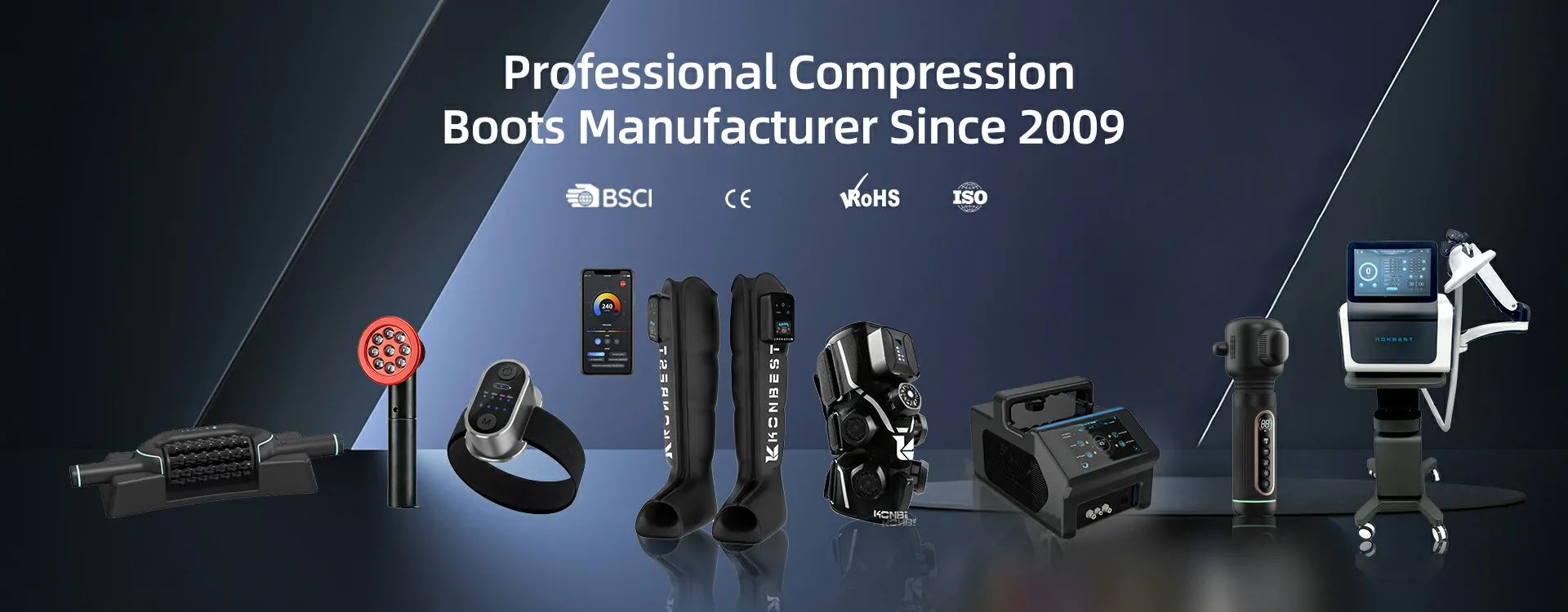
KONBEST lists CE, ISO, RoHS, and BSCI-related documentation. These are not interchangeable certifications, so B2B buyers should confirm the exact document, product scope, validity, and destination-market requirements for each order.
Factory inspection is also available for suitable B2B projects. This can help distributors and wholesalers review the manufacturing environment, production capacity, quality process, and product consistency before committing to a larger order.
For a medium or large purchasing program, the final sourcing checklist should include the approved sample, exact model number, technical specification, packaging, customization, MOQ, production schedule, inspection standard, warranty, and shipping plan.
View KONBEST compression boots for wholesale and B2B sourcing to compare 4-chamber, 6-chamber, and 8-chamber models and request specifications, samples, private label options, MOQ, lead time, and factory inspection support.
Q&A
What are the best compression boots for gyms?
Gyms can consider portable 4-chamber or 6-chamber models with rechargeable batteries, adjustable pressure, simple controls, and multiple massage programs. The right choice depends on customer type, frequency of use, and available space.
Which compression boots are suitable for clinics?
Clinics and recovery centers can consider professional 6-chamber or 8-chamber systems with adjustable pressure, multiple massage modes, clear controls, suitable airflow, rechargeable batteries, and low operating noise. The final model should match the facility's requirements and destination-market regulations.
What should I check before buying compression boots wholesale?
Check the chamber configuration, pressure range, massage modes, airflow, battery capacity, controls, noise, materials, sample quality, MOQ, lead time, packaging, warranty, quality inspection, and applicable compliance documents.
Can KONBEST provide private label compression boots?
Yes. KONBEST supports private label and OEM/ODM projects. Depending on the model and order, buyers can discuss logo, color, packaging, accessories, labels, and other customization requirements.
Can a compression boots manufacturer support large B2B orders?
Yes. KONBEST has a 12,000-square-meter manufacturing facility and five production lines, supported by R&D and quality inspection teams. Buyers can discuss production capacity, MOQ, lead time, inspection, and shipping before placing a large order.
Can distributors inspect the KONBEST factory?
KONBEST supports factory inspection for suitable B2B projects. Buyers can use the inspection process to review production facilities, quality control, manufacturing capability, and order preparation before a larger purchasing program.
Why should wholesalers offer different compression boot models?
Different customers have different requirements. A range of 4-chamber, 6-chamber, and 8-chamber compression boots allows a distributor to serve gyms, sports teams, clinics, recovery centers, fitness retailers, and private label brands with more suitable product choices.
How can I choose the right compression boots supplier?
Compare more than price. Review technical specifications, sample quality, factory capacity, customization ability, quality control, MOQ, lead time, documentation, warranty, and factory inspection support. A supplier that can support both the first order and future repeat orders is usually a stronger choice for B2B purchasing.
Table of Contents
- Table of Contents
- Why Compression Boots Are Important for Professional B2B Buyers
- What Makes a Professional Compression Boot Different?
- How to Choose the Right Model
- For Gyms and Fitness Clubs
- For Clinics and Recovery Centers
- For Sports Teams and Training Facilities
- How Distributors Can Build a Product Portfolio
- Private Label Compression Boots for Resellers
- How to Evaluate a Compression Boots Manufacturer
- Why Choose KONBEST for B2B Supply
-
Q&A
- What are the best compression boots for gyms?
- Which compression boots are suitable for clinics?
- What should I check before buying compression boots wholesale?
- Can KONBEST provide private label compression boots?
- Can a compression boots manufacturer support large B2B orders?
- Can distributors inspect the KONBEST factory?
- Why should wholesalers offer different compression boot models?
- How can I choose the right compression boots supplier?