
 EN
EN
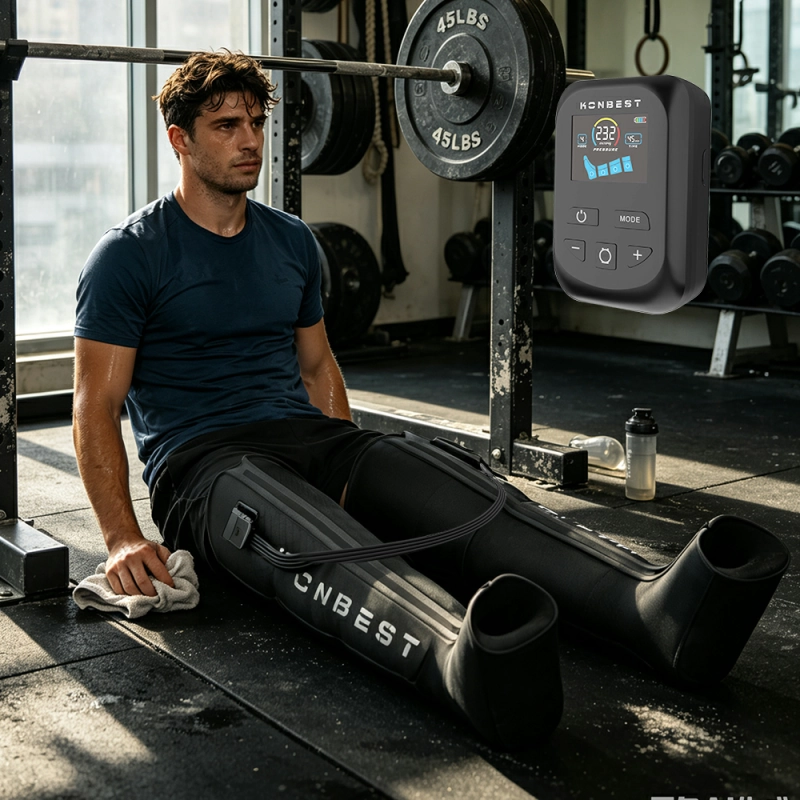
How to Match Compression Boots With Different Business Models
Choosing compression boots for a business is not the same as choosing a pair for personal use. When you buy 50, 100, 500, or more units, the wrong model can create stock problems, customer complaints, and a product range that is difficult to sell.
The smarter approach is to start with your business model. A distributor serving gyms may need portable and easy-to-use systems. A wholesaler supplying clinics may need models with more chambers and wider pressure control. An online reseller may prefer compact wireless products. A private label brand may need custom colors, packaging, logos, and accessories.
This guide explains how to connect each business model with the right compression boot configuration and how to evaluate a manufacturer before a medium or large order.
KONBEST has 17 years of sports recovery equipment R&D and manufacturing experience. Its products are sold in more than 100 countries, with more than 300 customized brand projects and experience with more than 20,000 professional athletes. The company operates a 12,000 m² factory with 5 production lines and professional R&D and QC teams, supporting OEM, private label, sampling, factory inspection, and bulk supply projects.
Table of Contents
- 1. Match the Product to the Business First
- 2. A Practical Range for Distributors
- 3. What Wholesalers Should Look For
- 4. The Right Approach for Resellers
- 5. Planning a Private Label Product
- 6. Match Product Features to Customer Needs
- 7. Product Choices for Different Applications
- 8. How to Plan a Medium or Large Order
- 9. What to Check in a Manufacturer
- 10. Why Work With KONBEST
- 11. Q&A
1. Match the Product to the Business First
There is no single compression boot that is perfect for every B2B buyer.
Before comparing quotations, define where the product will go after you receive it. This changes the product selection.
For example, a distributor may need three product levels because it serves different types of customers. A wholesaler may focus on models that are easy to stock and supply repeatedly. A reseller may care about portability and simple operation. A private label company needs to consider the product itself as well as branding and packaging.
Before contacting a compression boots manufacturer, write down your main requirements:
- Target customer
- Application environment
- Expected order quantity
- Required pressure range
- Number of chambers
- Wireless or wired operation
- Required treatment modes
- Customization requirements
- Expected delivery schedule
This gives the factory a clear purchasing brief and makes supplier comparisons much more accurate.
2. A Practical Range for Distributors
Distributors normally need products for several downstream customers. Selling only one configuration can limit their options.
A better plan is to create a simple three-level range.
Portable Model for Everyday Users
A compact 4-chamber system can be suitable for customers who want basic compression recovery at home, in a gym, or while traveling. KONBEST's 9490 series includes 4-chamber configurations, with selected versions offering rechargeable batteries and wireless operation.
Professional Model for Fitness and Recovery Centers
When customers want more compression zones and more treatment choices, a 6-chamber system can be a better fit. Selected KONBEST 9690 models provide 6 chambers, 6 modes, a 30–260 mmHg pressure range, and a 5200mAh battery.
Advanced Model for Professional Buyers
An 8-chamber system can sit at the higher end of the range. The KONBEST 9890 series includes 8-chamber configurations and selected versions provide a 30–260 mmHg pressure range, multiple modes, LCD touch control, and a 5200mAh battery.
This type of product structure helps a distributor answer different customer requirements without finding a new supplier for every segment.
3. What Wholesalers Should Look For
For wholesalers, compression boots wholesale purchasing is mainly about building a reliable product mix.
A wholesale catalog should be easy for downstream buyers to understand. If five models have almost the same specifications, it becomes difficult for sales teams to explain why customers should choose one over another.
Instead, give each model a clear purpose.
For example:
- 4 chambers for portable and everyday recovery
- 6 chambers for more advanced compression control
- 8 chambers for professional recovery environments
- Wireless versions for mobile use
- Higher-specification versions for dedicated recovery spaces
Specifications should support these positions. Pressure range, chamber number, battery capacity, inflation speed, treatment modes, display, and control method can all help separate one product from another.
For a wholesaler, this approach also makes inventory planning easier. Instead of buying large quantities of many similar products, you can concentrate on a smaller number of models with clear market roles.
4. The Right Approach for Resellers
Resellers usually need products that are easy to present online or in a store.
Portability can be especially useful. A customer may want to use compression boots at home after exercise, take them to a gym, or bring them while traveling.
KONBEST offers wireless compression configurations with rechargeable batteries. The 9490Pro, for example, uses a 3200mAh battery, 4 air chambers, 5 modes, a 30–240 mmHg pressure range, a detachable motor, LCD control, and remote or Bluetooth app control.
These features give a reseller several simple points to explain without making the product difficult to understand.
For an online sales channel, packaging and accessories also matter. Buyers should confirm what is included in the standard package and whether additional accessories can be customized before placing a larger order.
5. Planning a Private Label Product
Private label purchasing needs to start earlier than normal wholesale purchasing.
If the product will carry your brand, confirm the branding details before mass production. This includes logo position, color, packaging, accessories, labels, manuals, and other visual details.
KONBEST supports private label logo and color customization, packaging, and accessories. For a brand with several recovery products, these options can help keep the product range visually consistent.
A practical private label process can look like this:
- Select the base model
- Confirm technical specifications
- Discuss logo, color, and packaging
- Request and test a sample
- Approve the final version
- Confirm production and inspection requirements
- Start mass production
KONBEST supports 2-day sampling for applicable projects. The sample should be treated as the reference for the bulk order, so any important change should be confirmed before production starts.
6. Match Product Features to Customer Needs
When comparing a compression boots supplier, do not simply count how many functions a product has. Look at whether those functions solve a real customer requirement.
4, 6, or 8 Chambers?
More chambers mean more compression zones. A 4-chamber system may be enough for a simple portable product, while 6- or 8-chamber systems can provide a more segmented compression experience for professional product lines.
How Much Pressure?
Pressure adjustment gives users more control over the compression session. Selected KONBEST models offer a range up to 260 mmHg, while the 9490Pro supports 30–240 mmHg.
For B2B buyers, the correct range should be selected according to the target application and intended market rather than simply choosing the highest number.
Does Inflation Speed Matter?
Yes, especially in busy facilities. Faster inflation can reduce setup time between sessions. Selected KONBEST models use pumps with flow rates up to 15 L/min.
Is Noise Important?
It can be. Recovery rooms and clinics may prefer quieter equipment. Selected KONBEST 9690 models are specified at below 45 dB.
When Is a Larger Battery Useful?
A larger battery is useful when the equipment needs to be moved frequently or used away from a fixed power source. Selected 9690 and 9890 models use a 5200mAh battery, while other models use smaller batteries to keep the system more compact.
This is why a compression boots supplier should provide different configurations instead of pushing one standard product to every buyer.
7. Product Choices for Different Applications
Professional Sports Teams
Teams may use compression boots after training, games, long travel, or heavy exercise. Repeated use means durability, stable inflation, and easy operation are important.
For this market, a distributor can consider 6- or 8-chamber systems when customers need more compression zones and multiple programs.
Gyms and Fitness Clubs
Gyms usually need equipment that many different users can operate without complicated training. Portable wireless models can also make it easier to move equipment around the facility.
A distributor can supply compact models for general users and higher-specification systems for a dedicated recovery area.
Physiotherapy and Rehabilitation Centers
Professional facilities may have stricter purchasing requirements. They may review pressure adjustment, treatment modes, chamber structure, quality control, warranty, technical documents, and applicable certifications.
For regulated markets, buyers should confirm the exact documentation required for the selected model and destination country. Do not assume that a general factory certificate covers every product or application.
Recovery and Wellness Businesses
Recovery studios and wellness centers can benefit from a product range with different levels. A simple system can serve regular users, while a higher-specification system can be placed in a premium recovery room.
8. How to Plan a Medium or Large Order
Once the product range is clear, move to quantity planning.
Do not immediately place a large order across every available model. Start by selecting the models that match your main customers and request samples for evaluation.
After approval, lock the specifications for mass production.
For repeat purchasing, keep records of the approved model, chamber structure, pressure range, battery, accessories, packaging, logo, colors, and other customization details. This creates a clear reference for future orders.
A medium or large buyer should also confirm:
- MOQ for each model
- Sample lead time
- Mass production lead time
- Quality inspection method
- Packaging requirements
- Warranty terms
- Spare parts and accessories
- Shipping schedule
- OEM change approval process
KONBEST supports 7-day shipping for applicable projects, but the actual schedule depends on the model, quantity, customization, and order conditions. Confirm the final production and shipping timeline before each purchase.
9. What to Check in a Manufacturer
A low unit price can look attractive at the beginning. It is less attractive when the factory cannot maintain the same specifications for your next order.
For large B2B procurement, check the manufacturer itself.
Look at its production lines, R&D capability, QC process, factory size, customization experience, sample service, inspection support, and ability to handle repeat orders.
It is also useful to ask how the factory controls incoming materials, finished products, batteries, air pumps, accessories, packaging, and final assembly.
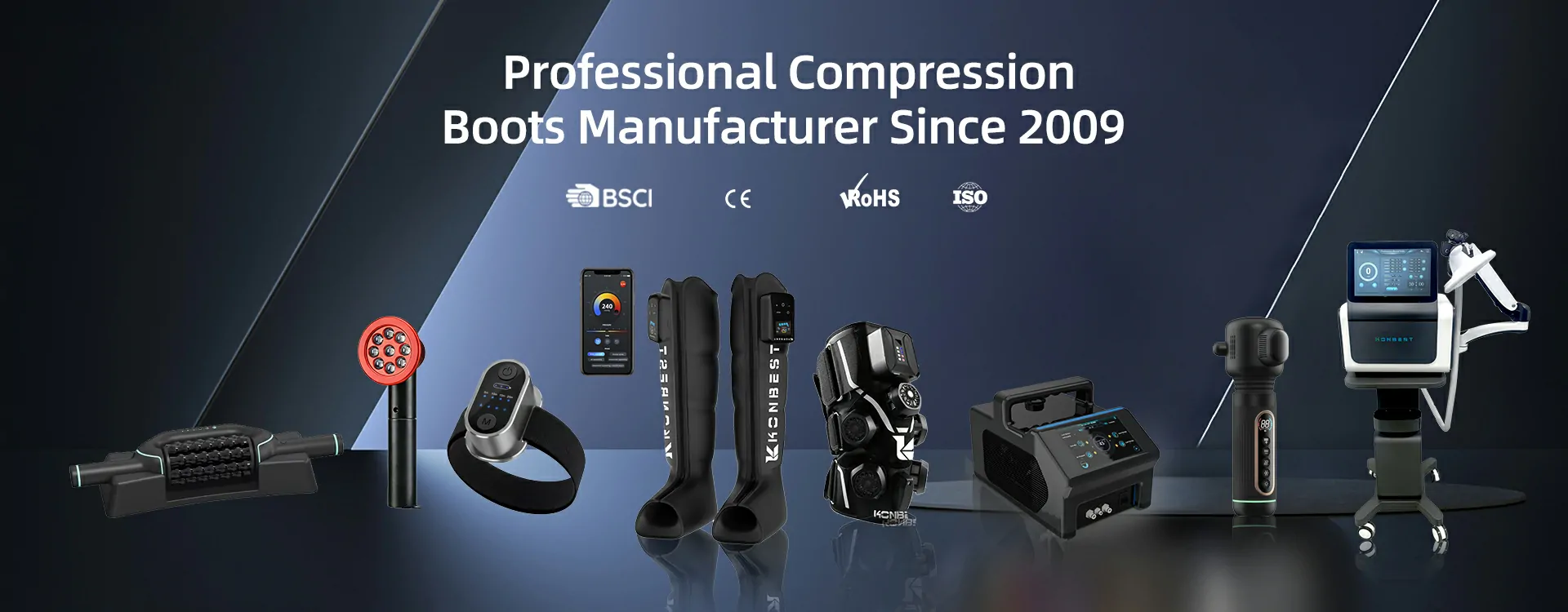
KONBEST has a 12,000 m² manufacturing facility and 5 production lines, supported by professional R&D and quality inspection teams. The company has completed more than 300 customized brand projects and supports factory inspection for B2B buyers.
Its product and quality systems include CE, ISO, RoHS, and BSCI certifications or standards, with exact documentation depending on the model and destination market.
For distributors, wholesalers, and resellers, this factory-level information can be much more useful than comparing product photos alone.
10. Why Work With KONBEST
A compression boot can be the first product in a recovery equipment catalog, but it does not have to be the last one.
KONBEST has a wider sports recovery equipment range, covering compression recovery, cold and hot therapy, red light therapy, massage, PEMF, and other recovery products. This gives B2B buyers the option to expand their product range through one manufacturing partner.
With 17 years of R&D and manufacturing experience, sales in more than 100 countries, more than 300 customized brand projects, experience with more than 20,000 professional athletes, a 12,000 m² factory, and 5 production lines, KONBEST can support different purchasing models.
For a distributor, the focus can be a multi-level product range. For a wholesaler, it can be stable bulk supply. For a reseller, it can be portable models with clear features. For a private label brand, the focus can be product customization and consistent packaging.
You can review the KONBEST compression boots range and compare models based on chamber number, pressure range, modes, battery, controls, portability, and application.
The right procurement decision is not about finding the model with the longest specification list. It is about finding the model that makes sense for your customers and then building a supply plan around it.
11. Q&A
What type of compression boots should a distributor buy?
A distributor should normally choose several clearly different models based on its customer groups. A compact 4-chamber model can serve everyday users, while 6- and 8-chamber models can target professional recovery applications.
Are compression boots suitable for wholesale purchasing?
Yes. Compression boots can be supplied to gyms, sports teams, clinics, rehabilitation centers, recovery studios, retailers, and other businesses. Wholesalers should select models with clear differences to make inventory and sales management easier.
What should I compare when buying compression boots in bulk?
Compare chamber number, pressure range, modes, inflation speed, battery capacity, control method, noise, accessories, warranty, certifications, MOQ, lead time, and customization support.
Can KONBEST make private label compression boots?
Yes. KONBEST supports private label logo, color, packaging, and accessory customization. OEM and ODM requirements can be discussed according to the project.
Can I get a sample before a bulk order?
Yes. KONBEST supports 2-day sampling for applicable projects. The actual timing depends on the selected model and customization requirements.
Can I inspect the KONBEST factory?
Yes. Factory inspection is supported for B2B buyers. This allows distributors, wholesalers, resellers, and private label brands to review the manufacturing environment and quality control process before placing a larger order.
Does KONBEST provide more than compression boots?
Yes. KONBEST has a wider sports recovery equipment range, including cold and hot therapy, red light therapy, massage, PEMF, and other recovery products. This can support buyers who want to build a broader recovery equipment catalog.
Table of Contents
- How to Match Compression Boots With Different Business Models
- Table of Contents
- 1. Match the Product to the Business First
- 2. A Practical Range for Distributors
- 3. What Wholesalers Should Look For
- 4. The Right Approach for Resellers
- 5. Planning a Private Label Product
- 6. Match Product Features to Customer Needs
- 7. Product Choices for Different Applications
- 8. How to Plan a Medium or Large Order
- 9. What to Check in a Manufacturer
- 10. Why Work With KONBEST
-
11. Q&A
- What type of compression boots should a distributor buy?
- Are compression boots suitable for wholesale purchasing?
- What should I compare when buying compression boots in bulk?
- Can KONBEST make private label compression boots?
- Can I get a sample before a bulk order?
- Can I inspect the KONBEST factory?
- Does KONBEST provide more than compression boots?